

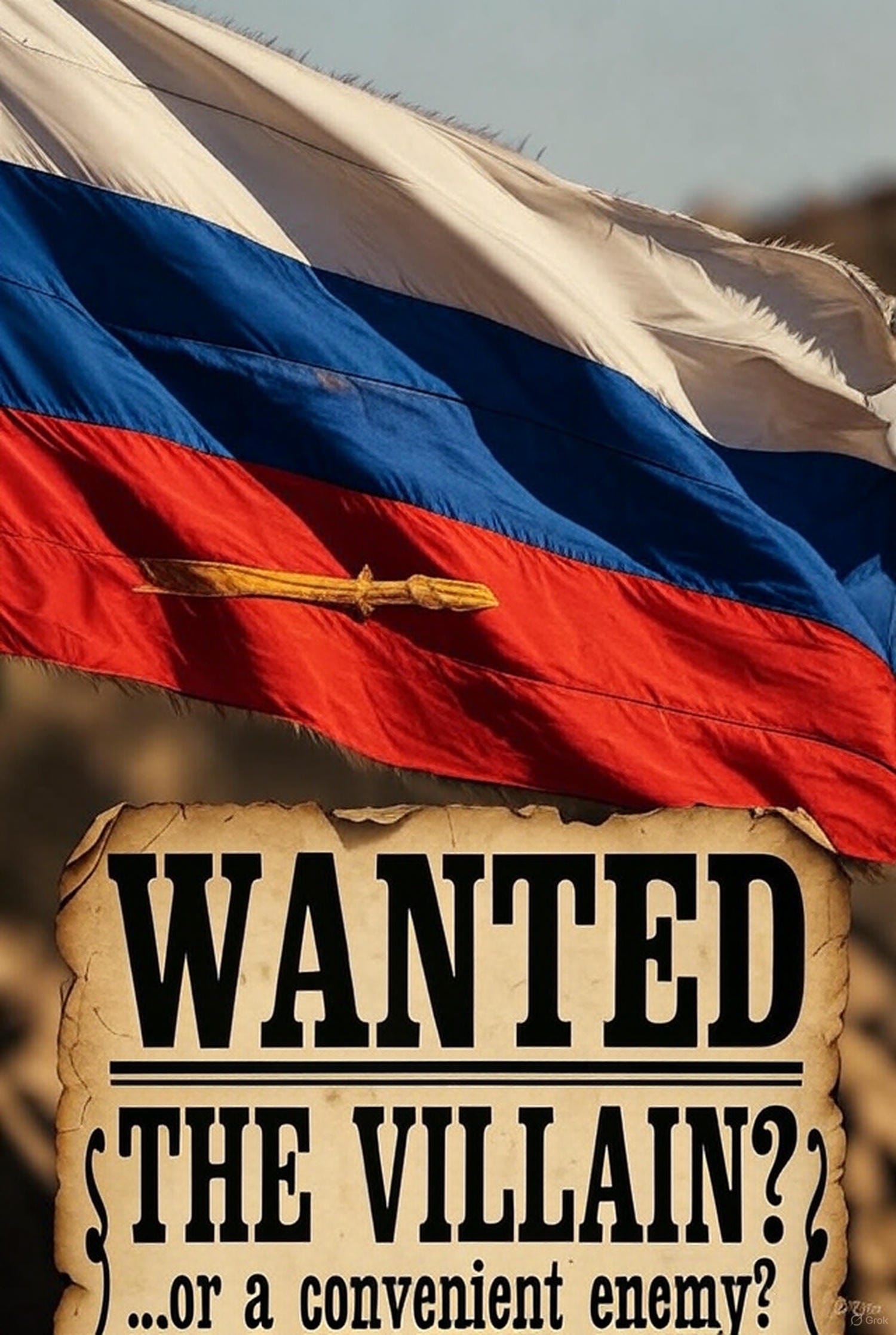
Since the collapse of the Soviet Union, the West—firmly led by the United States—has operated on a strategic logic that demands a permanent adversary. This adversary is not chosen because it is truly dangerous. It is chosen because without it, Washington struggles to justify the scale of its global militarisation, NATO’s open-ended expansion, or the enormous political and economic costs of maintaining a global sphere of influence.
Russia, devastated and plundered throughout the 1990s, was not selected as a “threat” because it was strong. It was selected precisely because it was diminished. It was large enough to frighten, familiar enough to activate Cold War imagery, and distant enough to demonise without meaningful resistance.
For three decades, the West has carefully maintained this caricature. Hollywood codified the Russian villain: cold, irrational, and cartoonishly cruel—an archetype instantly recognisable worldwide. Mainstream Western media transformed every Kremlin decision into part of some eternal imperial conspiracy. Government-funded think tanks labelled Russia a “terrorist state”, a threat that could only be confronted by superior Western force. This is not analysis. It is dogma.
The thesis is simple: Russia is not the villain the West desperately needs it to be. The West needs Russia as an enemy. Russia does not need the West as one. And few regions illustrate this more clearly than Central Europe—particularly Poland—where this Western need for a Monster has shaped politics, foreign policy, and strategic culture for more than two decades.
NATO Expansion: The Line That Was Never Meant to Be Crossed
After the Cold War, NATO faced a moment of genuine strategic ambiguity. An alliance created to contain the Soviet Union no longer had an adversary. It could have dissolved, restructured, or transformed into a political community. Instead, NATO embarked on the most aggressive military expansion of the post-war era.
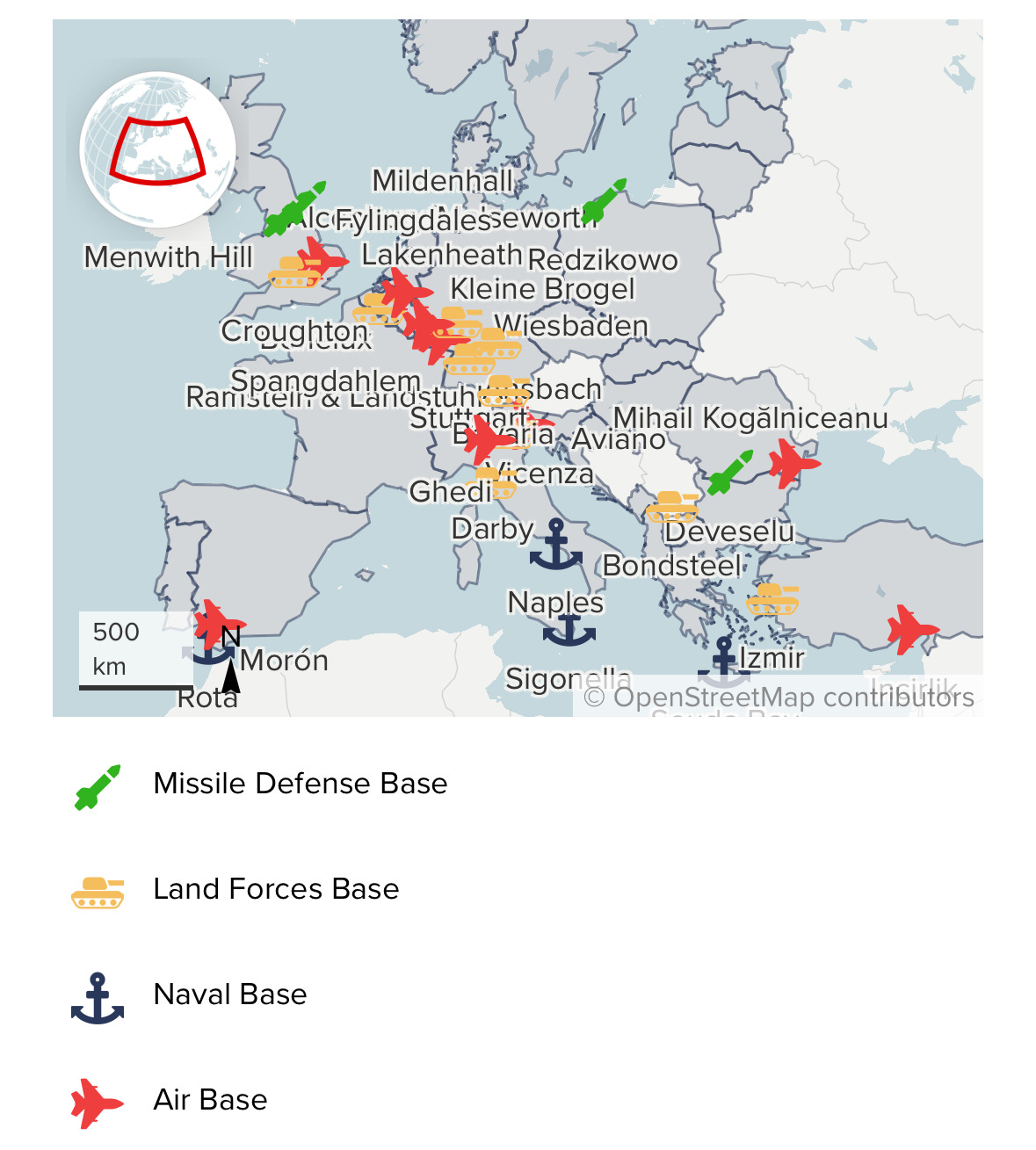
NATO and U.S. Military Expansion Across Europe After the Cold War
Poland, Hungary and the Czech Republic joined first. Then the Baltic states, Bulgaria, Romania, Slovakia, Slovenia, Croatia, Montenegro, North Macedonia, and eventually Finland and Sweden. Every move eastward was described as “defensive”, as though shifting a military bloc thousands of kilometres closer to another major power somehow increased stability.
For Moscow, this process represented a progressive collapse of its strategic depth. Yet for years, Russia limited itself to diplomatic protests and proposals for partnership. Even Vladimir Putin—universally presented in the West as an aggressive expansionist—spent his early presidency advocating cooperative structures with both NATO and the EU.
But on one issue there was unanimity in Moscow: Ukraine and Georgia could not join NATO. They had to remain neutral—not annexed, not subordinated, but neutral. As John Mearsheimer has consistently argued, great powers have immutable expectations of their immediate neighbourhood. A Chinese military base in Mexico would be intolerable to Washington. A Russian alliance with Canada would be perceived as an existential threat. The Cuban Missile Crisis remains a textbook example of American “red lines”.
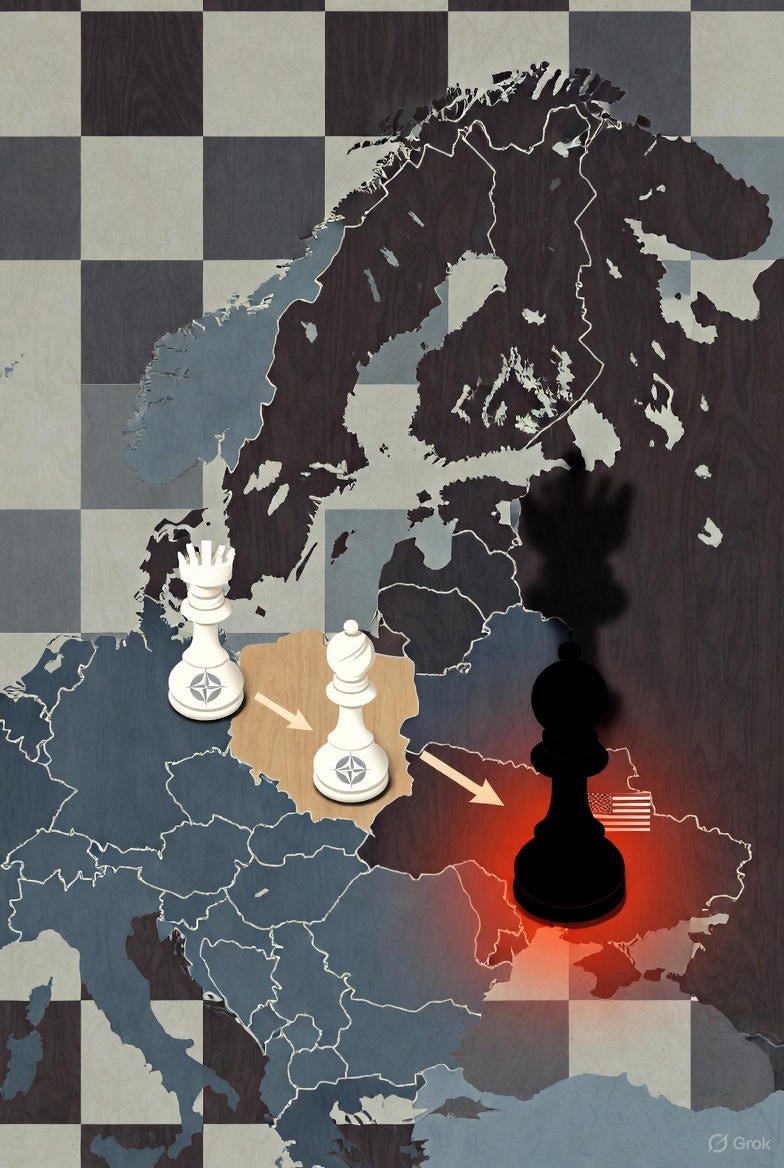
Yet when Russia expressed its own red lines, the United States reacted not with understanding but with provocation. Moscow’s concerns became an opportunity. By pushing NATO’s frontier toward Russia despite clear warnings, Washington ensured:
Europe’s continued dependence on the U.S.,
the justification for colossal military spending,
the consolidation of Western unity through fear,
the economic weakening of Russia,
and the empowerment of the military–industrial complex.
The West needed confrontation. Russia did not.
The scale of imbalance becomes clear when observing the reality of U.S. military presence on the continent: more than one hundred significant American bases across Europe, including missile defence installations in Poland and Romania, and the enormous Camp Bondsteel in Kosovo—constructed after the de facto Western-engineered detachment and informal annexation of a historically Serbian province, turned into a strategic outpost overlooking Serbia, the closest Russian partner on the continent. Never has so much American military power been positioned so close to Russia.
And yet Russia’s request was modest: no NATO bases in Kyiv or Tbilisi, no missiles minutes from Moscow, no hostile infrastructure on its immediate border.
Ukraine: From Leninist Creation to American Bastion
Modern Ukrainian statehood is, in many respects, a Soviet construction. Its borders, institutions, and political architecture were crafted by Lenin and later Soviet elites to ensure Ukraine’s alignment with Moscow. After 1991, this legacy created a paradox: Ukraine was independent, yet deeply integrated with Russia.
The 1994 Budapest Memorandum attempted to stabilise this arrangement. Russia recognised Ukraine’s borders, while Ukraine committed to neutrality and abandoned its nuclear arsenal—the world’s third largest.
For Moscow, this was a difficult but acceptable compromise: Kyiv and Crimea lost, but neutrality preserved. Ukraine would function as a geopolitical bridge, not a Western weapon.
This equilibrium did not survive Western intervention. Over the next two decades, Ukraine was transformed into a frontline state—politically, ideologically, and militarily. Its national identity, once complex and multi-layered, became increasingly defined as an instrument against Russia. Washington and Brussels completed the Soviet project in reverse: turning Ukraine into a political entity whose survival was predicated on opposing the very power that shaped its existence.
Competing Models of Intervention: Russian Stability vs. Western Disruption
The Western narrative of “Russian aggression” collapses under close inspection. The 2008 war in Georgia began with a Georgian assault on Tskhinvali — a fact rarely acknowledged in the West — and escalated only after Saakashvili pushed the country decisively toward NATO, despite Abkhazia and South Ossetia expressing a clear preference for alignment with Russia. Chechnya, frequently cited as evidence of Russian brutality, subsequently underwent extensive reconstruction; Grozny — levelled in 2000 — is today a modern, safe city with skyscrapers and infrastructure many European capitals could envy. The 2014 and 2022 escalations in Ukraine follow the same pattern: they were not unprovoked imperial gambits but the culmination of sustained Western encroachment — from the 2008 Bucharest pledge that Ukraine and Georgia “will become members of NATO” to Zelensky’s accelerated push toward NATO and the EU in 2021, despite Moscow’s explicit security warnings issued that December. Russia’s February 2022 intervention was therefore not a sudden “imperial leap,” but the continuation of a security logic it had articulated for decades.
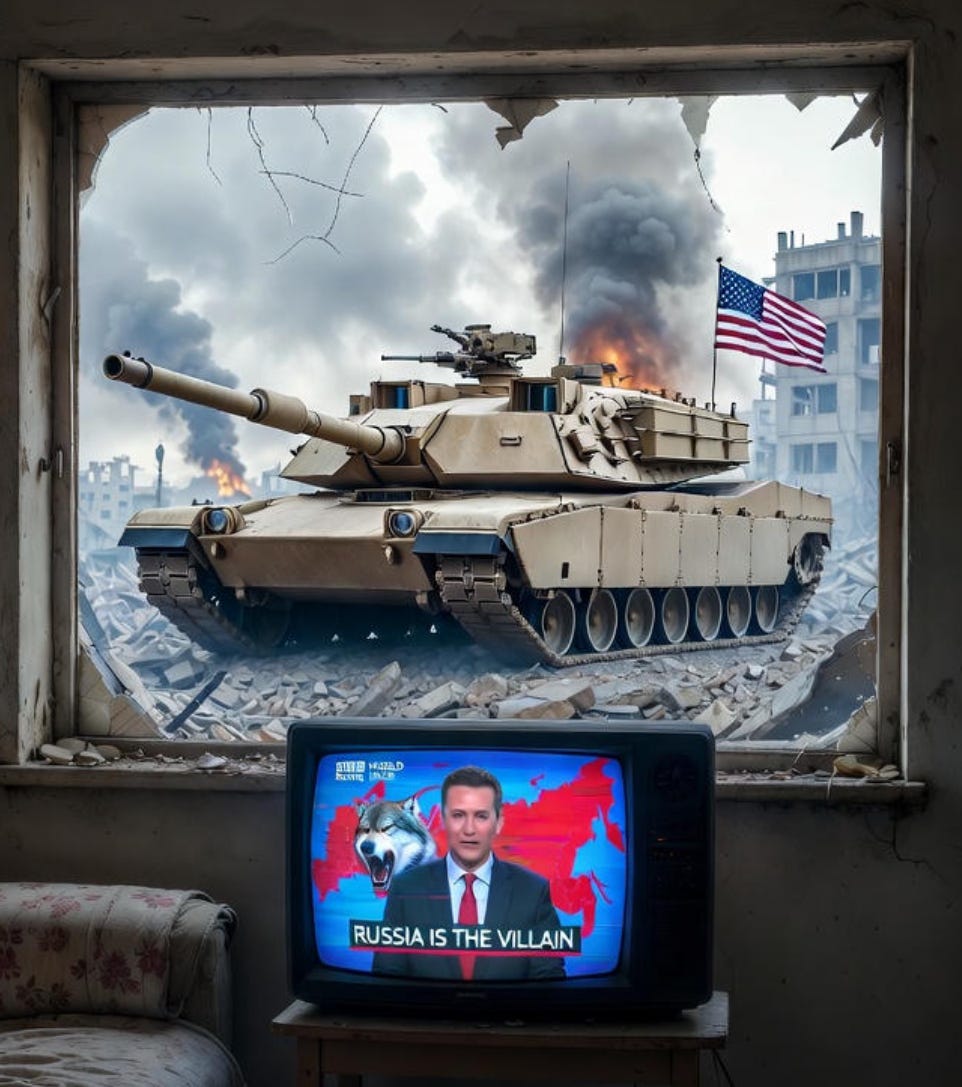
In stark contrast, U.S.-led “liberations” have repeatedly produced instability rather than rebuilding. Iraq was devastated over weapons that never existed, leaving behind a shattered state and millions dead or displaced. Libya — once Africa’s wealthiest nation — was reduced to a warlord-run wasteland under the pretext of “protecting civilians” in Benghazi, a threat that was grossly exaggerated and lacked evidence, while in reality Gaddafi irritated Washington and Paris with his plans for a gold dinar — a pan-African currency based on gold intended to displace the dollar and the French CFA in oil and commodity trade — generating chaos that reverberates to this day. Syria was turned into a Western proxy-war hub by the CIA’s billion-dollar Timber Sycamore operation, with arms supplied to rebels repeatedly falling into the hands of al-Qaeda affiliates and eventually ISIS. Afghanistan absorbed trillions of dollars only for the Taliban to reclaim power within days, while Yemen’s humanitarian catastrophe unfolded under the patronage of Western allies. Gaza in Palestine today witnesses U.S. political and financial support for operations widely criticised as ethnic cleansing, as Washington sponsors Israel’s unchecked actions across the Middle East — from Gaza’s devastation to escalations in Lebanon and Syria — turning a blind eye to war crimes and vetoing UN ceasefires, thereby fuelling regional proxy wars, refugee flows, and global instability.
These interventions were extractive and profit-driven, leaving behind collapsed states, mass casualties, and fertile ground for extremism.
If Russia is described as a “terrorist state,” then what vocabulary remains for America?
Central Europe and Poland as the Regional Amplifier of Western Escalation
Central Europe faces a fundamental strategic dilemma: continue performing the role assigned by the West—permanent frontline, permanent mobilisation, permanent fear—or redefine itself as an autonomous bridge between the West and Eurasia. Poland, with its demographic weight and economic capacity, could naturally lead such a shift. Instead, it has become trapped in a doctrine largely written abroad.
No country embraced this role with more zeal than Poland. Historical traumas, chronic deference toward Washington, and a desire to prove loyalty converged into a foreign policy positioning Poland as the loudest advocate of confrontation with Russia. The turning point came in 2008 during President Lech Kaczyński’s visit to Tbilisi, at the height of the Georgia–Russia war, where he warned:
“Today Georgia, tomorrow Ukraine, the day after tomorrow the Baltic States, then perhaps my country, Poland.”
This moment crystallised a political doctrine framing Russia not as a diplomatic actor but as an imminent civilizational threat.
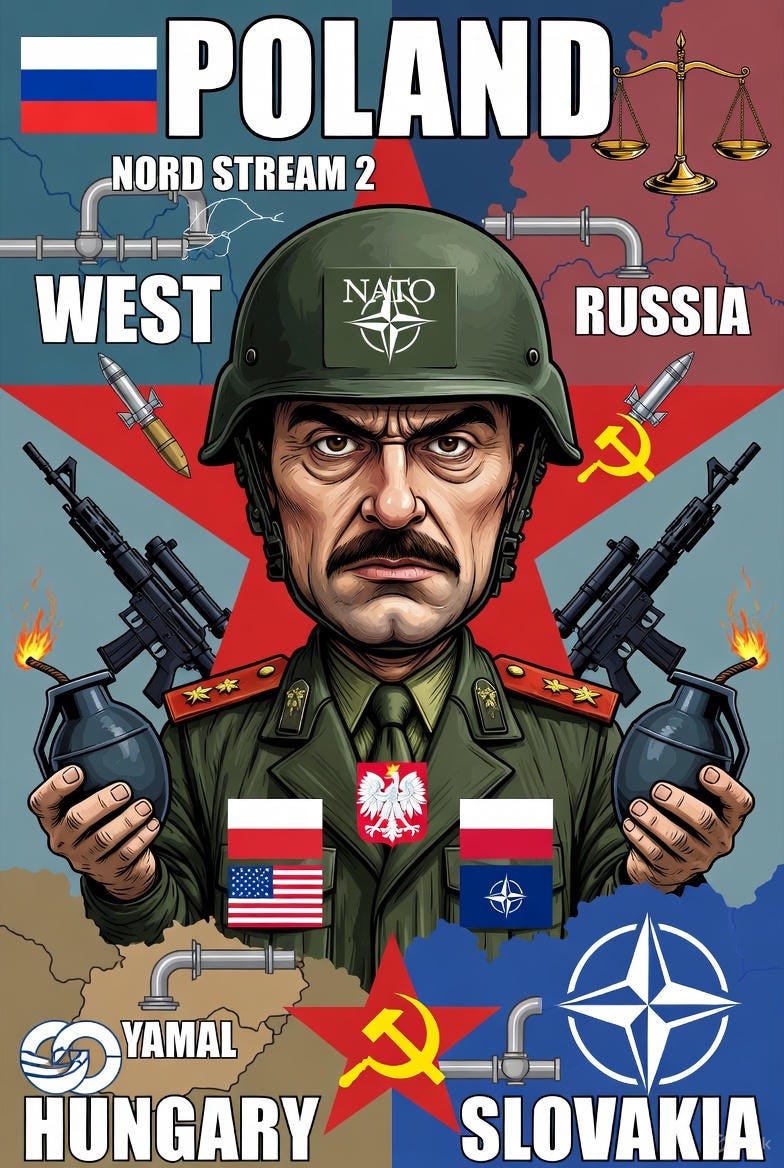
Throughout the 2010s—and especially after 2014—Poland reinforced this posture by systematically obstructing Russian energy projects such as Nord Stream 2: blocking the original financing consortium via UOKiK in 2016, winning a landmark case in the European Court of Justice that capped Gazprom’s use of the OPAL pipeline, and jointly with Denmark forcing a costly rerouting of the Baltic Sea section. Warsaw also refused to renew the Yamal transit contract beyond 2019, cut diplomatic energy engagement with Moscow to a minimum, and cultivated pervasive public suspicion toward Russia. Rather than acting as a bridge between the EU and Eurasia, Poland positioned itself as the West’s most confrontational and uncompromising forward outpost on the eastern flank.
After 2022, Poland emerged as one of Kyiv’s most enthusiastic promoters and suppliers, framing the conflict explicitly as “our war.” Senior officials embraced maximalist rhetoric, including Speaker of the Sejm Szymon Hołownia’s statement that Poland would “crush Putin into the ground.” From supplying weapons to publicly denouncing restraint, Poland consistently acted as the state expected to “shake the Monster awake.”
Yet despite years of provocations, Russia has not attacked a single NATO member. The Western narrative—“Ukraine falls today, Poland tomorrow”—has not materialised. Poland’s paradoxical role as a geopolitical battering ram—encouraged to provoke, yet facing no direct consequences—underscores how Central Europe has been instrumentalised for Western ambitions, while more balanced regional actors, like Hungary or increasingly Slovakia, are criticised for rationality.
Multipolarity: Russia’s Strategic “Sin”
In contrast to Poland’s amplification of Western escalation, Russia demonstrates strategic independence—what the West perceives as a “sin”: refusing to act according to external expectations. Instead of escalating to direct conflict with NATO, Moscow continues its regional operations in Ukraine while simultaneously deepening global partnerships, showing that it does not need Western approval or involvement to maintain influence.
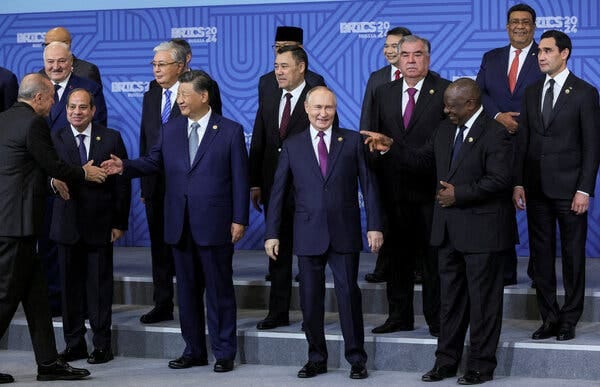
Far from being isolated, Russia has cultivated strong ties across Asia, Africa, and Latin America. Its growing alignment with China, strengthened relationships with India, Brazil, and other emerging powers, and the expansion of BRICS+ illustrate a rapidly consolidating multipolar world—encompassing nearly half of humanity and surpassing the G7 in PPP terms.
Sanctions were supposed to destroy Russia in months. The opposite happened—they hit Europe. Poland pays some of the world’s highest energy bills, while Hungary—thanks to favourable and stable contracts with Russian suppliers—has the lowest prices in the EU. Meanwhile, Russia has overtaken Germany and Japan to become the world’s fourth-largest economy (PPP), with steady growth since 2023.
By pursuing its objectives without yielding to Western pressure, Russia demonstrates that influence extends far beyond the Western sphere. It advances its agenda on its own terms, calmly and strategically, without being the villain the West insists it must be. Russia’s approach underscores a critical point: the world does not revolve around the West, and multipolarity is no longer theoretical—it is an active reality shaped by pragmatic, independent partnerships.
A World Without a Monster Is Too Complicated for the West
The world is becoming multipolar, and U.S. primacy is fading. Yet the West clings to the mythology of an omnipresent Russian threat. Without this threat, the West would have to face its own failures—from Afghanistan to Libya, from Syria to Yemen—and acknowledge that its own ideological project is fragmenting.
Russia is not saintly. It is a predictable great power operating within a rational geopolitical logic—far more consistent than the increasingly improvisational, ideology-driven strategies of the West.
The true threat to European stability is not Moscow. It is the West’s inability to function without a villain. Without the Monster, the West would have to confront its own declining hegemony.
And that, ultimately, is why the Monster must always be kept alive—even if it has to be repainted every single day.
Strong analysis and well laid out. Compelling and engaging writing too. And it’s all very true. Great summary of the main points and issues of the past 3 decades.
I’ll make a few comments and give a few of my thoughts.
‘Russia, devastated and plundered throughout the 1990s, was not selected as a “threat” because it was strong. It was selected precisely because it was diminished. It was large enough to frighten, familiar enough to activate Cold War imagery, and distant enough to demonise without meaningful resistance.’
Definitely. Because of its history with the West in what is its past incarnation, mutatis mutandis, the Soviet Union, it was worth a lot more as an enemy than friend. The US was too strong to worry much about the future and do what was best; and Russia was too weak to do anything about it.
This relationship follows an interesting Hegelian dialectic.
Russia tried to befriend the West during this time, but it was worth more as an pretend enemy than a friend, so it was kept at arm’s reach (first impossibility). This didn’t work, so Russia became more ambivalent and started to move towards Asia. This was when the false enemy became a real danger and the West started to come down heavier on it (second impossibility). And eventually, Russia had to return to full and actual confrontation, to right history and to right the imbalance (the transcendence is to not be with the West, or against it but within its system, but to transcend the system by creating its own = multipolarity - a new world order).
‘Poland, Hungary and the Czech Republic joined first. Then the Baltic states, Bulgaria, Romania, Slovakia, Slovenia, Croatia, Montenegro, North Macedonia, and eventually Finland and Sweden. Every move eastward was described as “defensive”, as though shifting a military bloc thousands of kilometres closer to another major power somehow increased stability.’
Definitely. This looks like defence to no one at all. Everyone knows what it was. The US used the real and imagined grievances of Eastern and Central Europe to expand NATO. France and Germany pushed back against this, as they should have, up until the wrong sort of leaders came to power.
‘As Jhttps://www.mearsheimer.com/wp-content/uploads/2019/06/Why-the-Ukraine-Crisis-Is.pdf has consistently argued, great powers have immutable expectations of their immediate neighbourhood. A Chinese military base in Mexico would be intolerable to Washington. A Russian alliance with Canada would be perceived as an existential threat. The Cuban Missile Crisis remains a textbook example of American “red lines”.’
Yes, he’s been doing great work for years. The war was predicted by people like George Kennan even before Putin came to power too.
‘Russia’s February 2022 intervention was therefore not a sudden “imperial leap,” but the continuation of a security logic it had articulated for decades.’
They paint it as if Russia just woke up one day and freaked out. The West loaded the gun for 3 decades until one day Russia just said enough is enough and pulled the trigger. This is also why many people think Russia is getting a much better deal with Ukraine. It was pushed into a corner for decades with all of its concerns and interests ignored. Not having to go to war and being listened to and having a stable non-aligned Ukraine would have been far preferable for most Russians. In the long run, multipolarity is better, but this may have come about anyway in a slightly different way.
‘By pursuing its objectives without yielding to Western pressure, Russia demonstrates that influence extends far beyond the Western sphere. It advances its agenda on its own terms, calmly and strategically, without being the villain the West insists it must be. Russia’s approach underscores a critical point: the world does not revolve around the West, and multipolarity is no longer theoretical—it is an active reality shaped by pragmatic, independent partnerships.’
Eloquent summary of where the article has been heading and where we are now.
‘Russia is not saintly. It is a predictable great power operating within a rational geopolitical logic—far more consistent than the increasingly improvisational, ideology-driven strategies of the West.
The true threat to European stability is not Moscow. It is the West’s inability to function without a villain. Without the Monster, the West would have to confront its own declining hegemony.
And that, ultimately, is why the Monster must always be kept alive—even if it has to be repainted every single day.’ ‘
Put perfectly. Very strong piece - eloquent, erudite, compelling, factual and very true. I’ll restack something.
"The whole aim of practical politics is to keep the populace alarmed (and hence clamorous to be led to safety) by an endless series of hobgoblins, most of them imaginary."
-H.L. Mencken
***
"The village needs an enemy"
-Killary "Rotten" Clinton, probably the most disgusting war pig ever..